WE FLOW
WE FLOW
Weflow is a B2B digital product aimed at providing companies and businesses with the tools to boost productivity and performance by focusing on improving the well-being and mental health of their teams.
This project consisted of creating a wellness app with a team of three people. There are already a lot of apps on the market so the challenge here was to find a niche, a new approach to tackle health-related problems.
Weflow is a B2B digital product aimed at providing companies and businesses with the tools to boost productivity and performance by focusing on improving the well-being and mental health of their teams.
This project consisted of creating a wellness app with a team of three people. There are already a lot of apps on the market so the challenge here was to find a niche, a new approach to tackle health-related problems.
Weflow is a B2B digital product aimed at providing companies and businesses with the tools to boost productivity and performance by focusing on improving the well-being and mental health of their teams.
This project consisted of creating a wellness app with a team of three people. There are already a lot of apps on the market so the challenge here was to find a niche, a new approach to tackle health-related problems.
Weflow is a B2B digital product aimed at providing companies and businesses with the tools to boost productivity and performance by focusing on improving the well-being and mental health of their teams.
This project consisted of creating a wellness app with a team of three people. There are already a lot of apps on the market so the challenge here was to find a niche, a new approach to tackle health-related problems.
Client
Portfolio
Year
2024
Category
Well-being
Research
Research
Throughout our lives, we spend an average of 85.000 hours at work. We conducted some research about the consequences of mental health issues in the workplace.
The main ones are decrease in productivity, employee turnover, and less creativity.
To know more about this problem, we created a survey to ask working people about how they feel at work.
We found out that:
100% of employees have experienced stress and/or anxiety.
86% have considered changing job/career to improve their mental health.
50% share the opinion that management do not know how to support mental health & well-being.
What do managers say?
We conducted interviews to know more about the manager’s point of view on this subject.
According to the answers, we could tell there were some needs we had to focus on to approach our solution design:
Need for leadership & management trainings.
Improving interpersonal and communication skills.
Provide strategies to promote well-being.
So, all of our findings led us to consider the following problem statement:
"Managers need tools to prioritize and promote the mental health and wellbeing of employees because they want to increase productivity and improve the workplace."
Throughout our lives, we spend an average of 85.000 hours at work. We conducted some research about the consequences of mental health issues in the workplace.
The main ones are decrease in productivity, employee turnover, and less creativity.
To know more about this problem, we created a survey to ask working people about how they feel at work.
We found out that:
100% of employees have experienced stress and/or anxiety.
86% have considered changing job/career to improve their mental health.
50% share the opinion that management do not know how to support mental health & well-being.
What do managers say?
We conducted interviews to know more about the manager’s point of view on this subject.
According to the answers, we could tell there were some needs we had to focus on to approach our solution design:
Need for leadership & management trainings.
Improving interpersonal and communication skills.
Provide strategies to promote well-being.
So, all of our findings led us to consider the following problem statement:
"Managers need tools to prioritize and promote the mental health and wellbeing of employees because they want to increase productivity and improve the workplace."
Throughout our lives, we spend an average of 85.000 hours at work. We conducted some research about the consequences of mental health issues in the workplace.
The main ones are decrease in productivity, employee turnover, and less creativity.
To know more about this problem, we created a survey to ask working people about how they feel at work.
We found out that:
100% of employees have experienced stress and/or anxiety.
86% have considered changing job/career to improve their mental health.
50% share the opinion that management do not know how to support mental health & well-being.
What do managers say?
We conducted interviews to know more about the manager’s point of view on this subject.
According to the answers, we could tell there were some needs we had to focus on to approach our solution design:
Need for leadership & management trainings.
Improving interpersonal and communication skills.
Provide strategies to promote well-being.
So, all of our findings led us to consider the following problem statement:
"Managers need tools to prioritize and promote the mental health and wellbeing of employees because they want to increase productivity and improve the workplace."
Research
Throughout our lives, we spend an average of 85.000 hours at work. We conducted some research about the consequences of mental health issues in the workplace.
The main ones are decrease in productivity, employee turnover, and less creativity.
To know more about this problem, we created a survey to ask working people about how they feel at work.
We found out that:
100% of employees have experienced stress and/or anxiety.
86% have considered changing job/career to improve their mental health.
50% share the opinion that management do not know how to support mental health & well-being.
What do managers say?
We conducted interviews to know more about the manager’s point of view on this subject.
According to the answers, we could tell there were some needs we had to focus on to approach our solution design:
Need for leadership & management trainings.
Improving interpersonal and communication skills.
Provide strategies to promote well-being.
So, all of our findings led us to consider the following problem statement:
"Managers need tools to prioritize and promote the mental health and wellbeing of employees because they want to increase productivity and improve the workplace."
Design
Design
Taking into account we were addressing issues with mental health and well-being primarily in the corporate world, we believed that the main attributes to describe the weflow brand and design were: sophisticated, professional and reliable.
So, when it came to the choice of colour palette, we resorted to colour theory and decided to make blue our accent colour, to give the design a familiar, corporate and trustworthy image.
Taking into account we were addressing issues with mental health and well-being primarily in the corporate world, we believed that the main attributes to describe the weflow brand and design were: sophisticated, professional and reliable.
So, when it came to the choice of colour palette, we resorted to colour theory and decided to make blue our accent colour, to give the design a familiar, corporate and trustworthy image.
Design
Taking into account we were addressing issues with mental health and well-being primarily in the corporate world, we believed that the main attributes to describe the weflow brand and design were: sophisticated, professional and reliable.
So, when it came to the choice of colour palette, we resorted to colour theory and decided to make blue our accent colour, to give the design a familiar, corporate and trustworthy image.
Development
Development
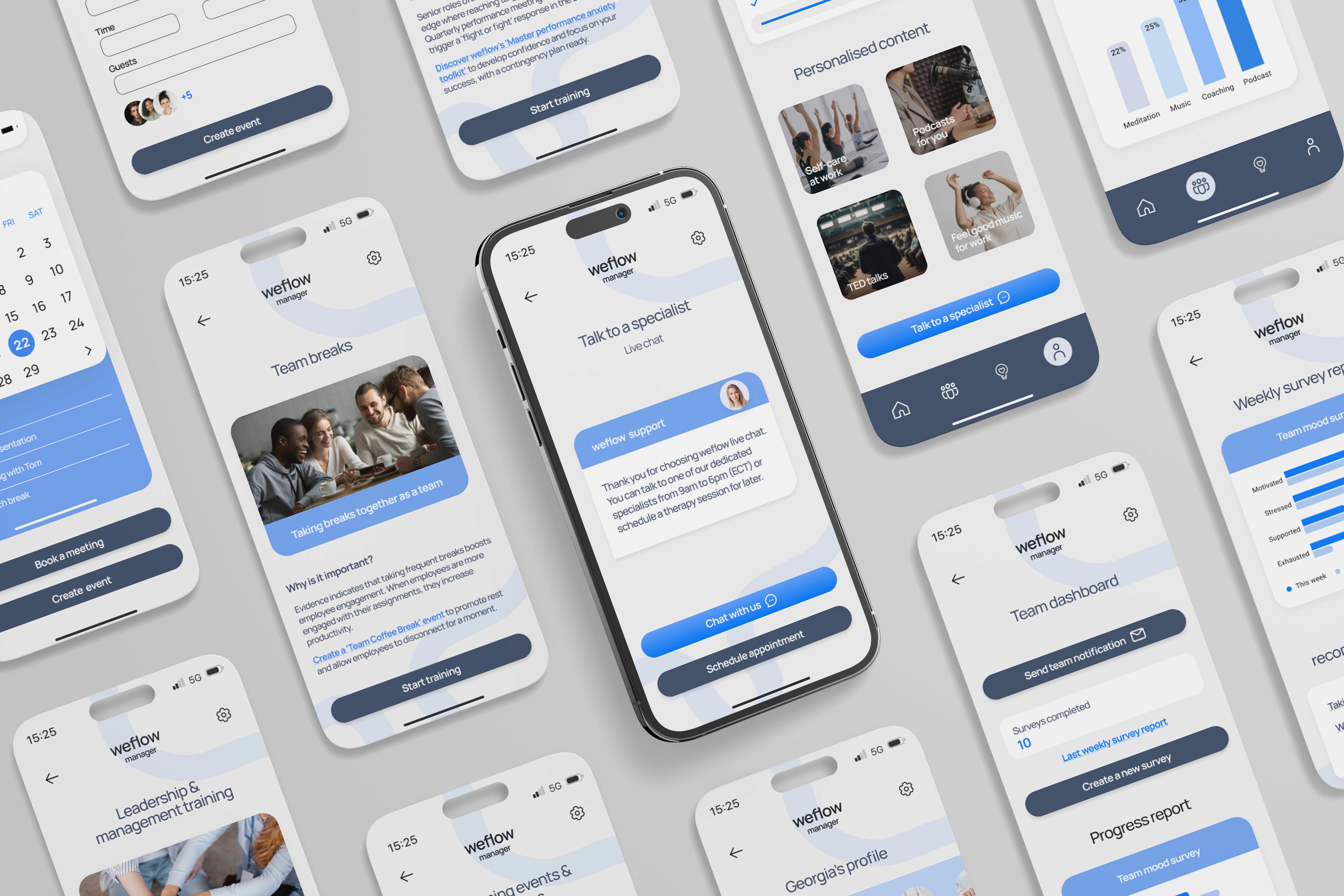
The weflow app proposal was first designed considering two versions of the app: weflow manager, and weflow team. We finally focused on developing the former.
Our value proposition was focused on allowing manager users to:
Engage with their teams with daily well-being challenges.
Keep track of team well-being and productivity through weekly surveys.
Access leadership and management training content.
Organise events and book meetings to promote well-being in the workplace.
Talk to a specialist or book therapy sessions at convenient times.
Send team or individual notifications.
We also developed an interactive onboarding process to guide users through the app’s features, ensuring a smooth and informative introduction.
The weflow app proposal was first designed considering two versions of the app: weflow manager, and weflow team. We finally focused on developing the former.
Our value proposition was focused on allowing manager users to:
Engage with their teams with daily well-being challenges.
Keep track of team well-being and productivity through weekly surveys.
Access leadership and management training content.
Organise events and book meetings to promote well-being in the workplace.
Talk to a specialist or book therapy sessions at convenient times.
Send team or individual notifications.
We also developed an interactive onboarding process to guide users through the app’s features, ensuring a smooth and informative introduction.
Development
The weflow app proposal was first designed considering two versions of the app: weflow manager, and weflow team. We finally focused on developing the former.
Our value proposition was focused on allowing manager users to:
Engage with their teams with daily well-being challenges.
Keep track of team well-being and productivity through weekly surveys.
Access leadership and management training content.
Organise events and book meetings to promote well-being in the workplace.
Talk to a specialist or book therapy sessions at convenient times.
Send team or individual notifications.
We also developed an interactive onboarding process to guide users through the app’s features, ensuring a smooth and informative introduction.

Concept
Concept
Using weflow app users can benefit from a holistic approach to well-being in the workplace, starting by providing leadership with a positive and effective management system, and employees with a safe space to communicate and thrive.
Using weflow app users can benefit from a holistic approach to well-being in the workplace, starting by providing leadership with a positive and effective management system, and employees with a safe space to communicate and thrive.
Concept
Using weflow app users can benefit from a holistic approach to well-being in the workplace, starting by providing leadership with a positive and effective management system, and employees with a safe space to communicate and thrive.